



AI in manufacturing: the question is no longer ‘if’, but ‘how’

AI has moved quickly. When I took over as CEO of West Yorkshire Manufacturing Services, Artificial Intelligence was being talked about, but for many manufacturers, particularly SMEs, it still felt a bit distant.
That's changed. Over the last 12 months, we've seen a huge increase in manufacturers wanting to understand AI and, more importantly, what they can actually do with it.
Most manufacturers I speak to aren't interested in the hype. They want to know whether AI can save time, reduce costs, improve quality or make running their business easier. If it can't, quite rightly they'll ask: why bother?
We're already seeing it make a difference
Initially, much of the conversation around AI focused on office-based tasks – writing documents, analysing information or taking some of the pain out of administration. There's plenty of value in that, but AI is now moving further into manufacturing operations.
We're seeing growing interest around estimating, production scheduling, quality monitoring, data analysis and process automation. Businesses are using AI to collate data, automate repetitive tasks, develop business systems and connect tools that previously didn't speak to each other.
A good example locally is Siddall & Hilton, who have used AI to support the development of systems across the business – from sales and customer management through to technical and production. It's helping connect information, improve processes and give people better access to what they need.
At the more advanced end, AI is being integrated across organisations to support better decision-making, productivity and quality, alongside significant time and cost savings. That's what manufacturers are interested in – not a clever AI demo or a presentation about the factory of 2040, but what it can do for their business now.
Don't assume AI isn't already in your business
When I ask business owners whether they've adopted AI, quite often the answer is, “No, not yet.” My response is usually: are you sure?
There's a fair chance somebody is already using it – drafting emails, summarising documents, researching suppliers or creating presentations. That's not necessarily a problem; the issue is whether the business knows it's happening and has given employees sensible guidance.
What information are people putting into AI tools? Could it include commercially sensitive information, customer data or intellectual property? Technology has moved quickly and, for some businesses, their policies and procedures haven't kept up.
AI can be wrong – confidently wrong
We also need to get away from the idea that because AI produces a polished answer, it must be right. It isn't, and we've already seen AI-generated information and images published under company brands that are clearly inaccurate or simply don't fit the business.
AI is a powerful business tool, but it's still a tool. If you wouldn't send an important quotation, quality document or customer communication without checking it, why treat AI-generated content differently?
Use it to make things quicker and easier, but make sure somebody checks the output and takes responsibility for it.
Start with the problem, not the AI tool
My advice to SMEs is straightforward. Don't buy an AI subscription because somebody on LinkedIn has told you it'll transform your business. Start by looking at the problems you're trying to solve.
What takes too long? Where are people duplicating work? Where does information get stuck and what jobs do your team hate doing? Once you understand those problems, you can decide whether AI can genuinely help.
You also need to put the foundations in place. Have an AI strategy, clear policies and procedures, and make sure managers and staff understand how the technology should (and shouldn’t) be used.
It doesn't need to be a chunky document gathering dust in a filing cabinet. It needs to be clear, practical and relevant to your business.
Take your people with you
Some employees are understandably concerned about AI and what it could mean for their jobs. What we're actually seeing in many businesses is AI removing repetitive, time-consuming tasks and freeing people to do more valuable work.
But you need to explain that and involve your team. Ask them where AI could help, because the person doing a job every day will often know exactly where time is being wasted and may spot opportunities that management won't.
Taking people with you isn't just about easing concerns. Done properly, involving your workforce can help you identify some of the best opportunities for using the technology.
Manufacturers need practical support
Manufacturers don't need another presentation telling them AI is coming. They need practical support, relevant training and help working out what to do next.
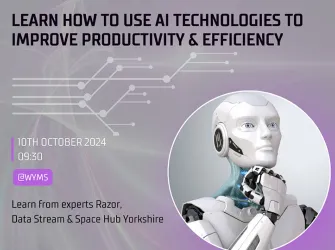
That's why WYMS has been working with higher education and industry partners to develop practical AI support for manufacturers.
Our AI Diploma introduces what AI can do now, how to get better results and how to use it safely. The AI Practitioner programme goes deeper into applications and automation, while integration projects and technical support can help businesses apply AI to specific processes and across the wider organisation.
We're also bringing manufacturers together through showcase and round table events. Businesses that have implemented AI can share what worked, what didn't and what they learned with those just starting out – which, for me, is far more useful than another AI sales pitch.
Don't ignore it. But don't panic either.
Nobody knows exactly where AI will be in five years – or even two – but manufacturers need to take notice. That doesn't mean throwing money at every new platform or changing processes that already work just because AI is fashionable.
Take a proper look at your business. Find the problems and processes taking too much time, put sensible rules in place and bring your people with you.
Then start small, see what works and build from there. You don't need to become an AI business overnight, but doing nothing probably isn't a strategy either.